
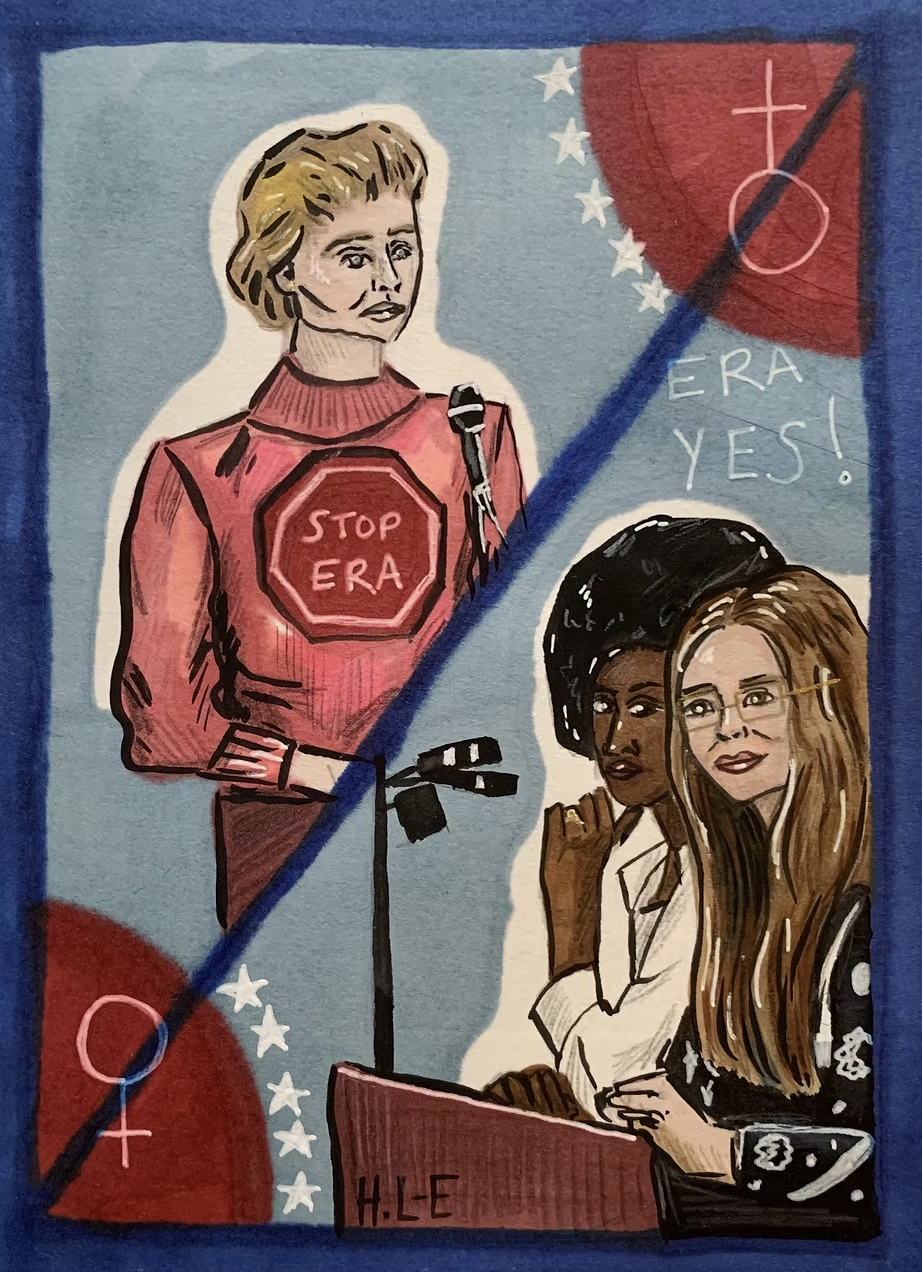
Artwork by Holly Evans (Instagram: @hollylawrensonevans_art)
FX’s drama portrays a political war between American women in the 1960s & 70s, but can it illuminate how women continue to operate within society at large today? Olivia Humphrey evaluates the series’ more subtle indicators towards modern feminist debate.
Whilst watching Cate Blanchett’s command of a drawing room filled with middle-class housewives, each one bewitched by her galvanising rhetoric of internalised patriarchy, I find myself becoming increasingly exasperated. I imagine this reaction was shared by many of those who have been following FX’s historical drama, Mrs America. Sitting alongside my mum as the tirade reached climax, preparing a biting remark, she looks at me and says, “But she’s absolutely right.”
Mrs America dramatizes the narrative of the movement to get the Equal Rights Amendment ratified in the US, and the unanticipated counterattack from conservative campaigner Phyllis Schlafly (Blanchett). An illustrious cast, if nothing else, elevates the production’s profile; recurring members include Rose Byrne (Neighbours), Uzo Aduba (Orange is the New Black), Elizabeth Banks (The Hunger Games) and Sarah Paulson (American Horror Story), to name a few. Relaying the accounts of the leading women of the era – Schlafly, alongside renowned second-wave feminists, including Shirley Chisholm, Gloria Steinem and Betty Friedan – the miniseries investigates how this theatre of war throughout the 1970s and 80s altered the American political sphere forever.
Schlafly’s address in question, from the first episode of the nine-part series, is masterfully portrayed by Blanchett, who relays the contemptuous, yet keenly intelligent mechanisms of her vernacular and body language. The result is incendiary, riddled with personal strikes on Freidan and Steinem of the Women’s Liberation Movement. One statement, however, has continued to reverberate around my house: “What is going to happen if you push women out into the workforce, is that they are going to find themselves with two full-time jobs. And they’re going to be exhausted and unhappy, and feel like they’re not doing either well.” The smug resonance holds more truth than is comfortable to admit.
At a first glance, this crusade perhaps seems worlds away from my own sphere of existence. As a young, white, female student, living in one of the most affluent cities in the UK, I am able to live a privileged lifestyle. I have access to free healthcare, incorporating sexual health, meaning I have autonomy over my reproductive rights. I have access to a community where LGBTQA individuals aren’t merely tolerated, but celebrated. What’s more, I have been actively encouraged to enrol onto an art degree – an arguably fiscally insecure decision – because I was lucky enough to grow up in a household where our finances were deemed stable enough to support our outlandish ambitions. In short: I have been afforded the luxury of idealism. This is where my mother and I differ – life has moulded her into a steadfast realist. Thrust into a career as a general practitioner by her parents, my mother’s life, up to the age of thirty-two, saw her check all the boxes of a respectable existence: career, husband, children, all whilst maintaining a size 8 waistline. However, throughout the majority of my childhood and adolescence, she functioned as a single mother, essentially balancing two full-time posts. Herein lies her sympathy with Schlafly’s rationale that, when given opportunities to do anything, women are expected to be everything.

Leave a Reply