
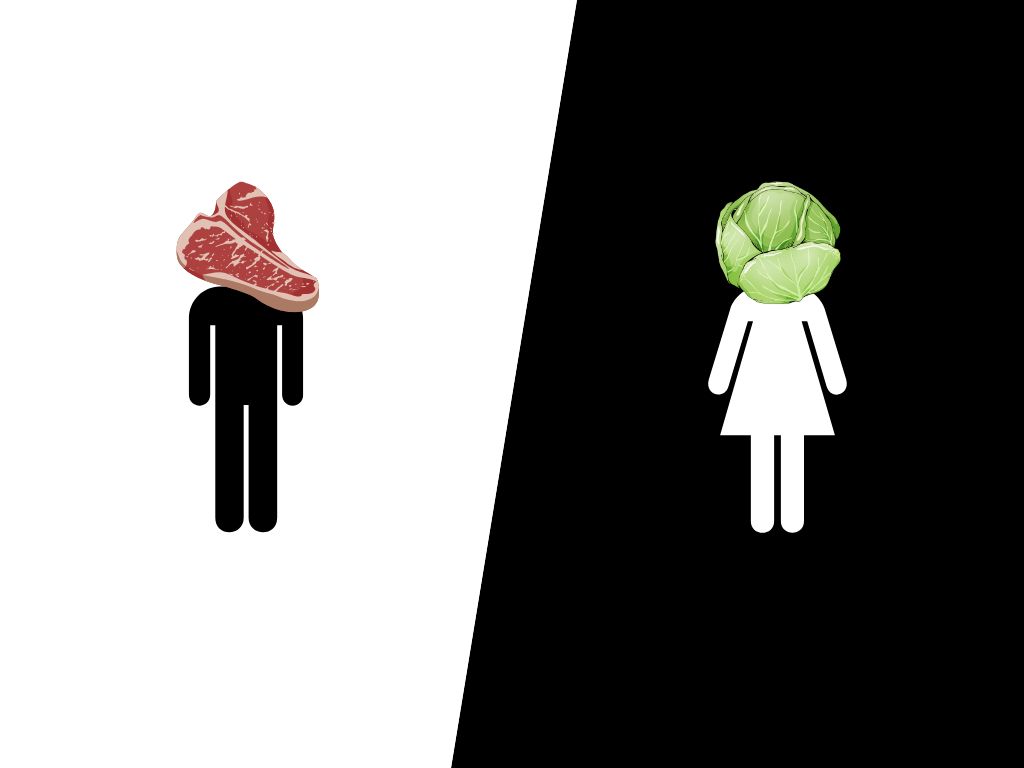
Illustration and article by Asumi Kato (IG: lmusa.k)
Tasty, But
I have a friend who used to take me to a vegan restaurant.
It was a warm, typical spring day two years ago. Under the sunshine from a window, I was texting him from behind my textbook as we were going to meet up for lunch after school.
“I’m not very hungry, so I wanna grab something light.”
A few minutes after seeing this message, he sent me the address of a nearby vegan place. I was a little surprised, though pleasantly, as he wasn’t vegetarian in any way.
“Looks good,” I typed without asking anything, and we went to the eatery afterwards.
We sat outside on a seat near the cherry blossom trees, drinking lemonade, our plates full. It wasn’t really a light meal anymore.
“If every vegan food tasted this way, I could go vegan,” he said with a contented smile, taking a break from eating.
“Yeah, it’s really good,” I replied.
We ended up returning to this place a few times following that day.
Two years passed. After we both entered university, there was a period when we did not text as we had done before. I somehow sensed, however, that he had changed.
Meeting up for the first time in several months, we were going to have lunch, as we did two years ago.
“There’s a restaurant I wanna go to,” I said. He nodded, “Let’s go there, then.” Same old, same old conversation.
On the way, he asked me, “What kind of restaurant is it?” I said, “It’s the best vegan restaurant in the city,” and he went, “Oh, it’s vegan,” weary.
I got a strange, somewhat uncomfortable feeling. “He’s never got annoyed by my pick like that,” thinking to myself. I had to realise that things were not the same as two years ago.
Later in the day, he said, “The meal I had at the restaurant was tasty. But plant-based food isn’t for me.”
As a Food Lover
I love to eat. So do my family and (most of?) my friends, including the one in the story. I genuinely enjoy having good food, but going to restaurants or cafes and spending time with people I like makes the experience even better.
That is why I deeply hate it when there is emotional dissonance about it, as the story depicts. It was not my first time encountering some tensions regarding food like this, but this incident stood out to me because it represented the transition from school to university. As a social anthropology student, I could not help but wonder why this shift might have happened. The more I thought about it, the more interesting thoughts came to my mind concerning politics, gender, and identity.
The questions I ask in this article are simple: What prevents us from appreciating good food and quality time? How does society shape our very mundane sensory experiences, like eating?
Through the lens of food, I advocate in this article for essence over labels, fluidity over rigidity, and grey over black and white. We should live in a society where the taste of food matters more than what it represents; grown men can freely appreciate softness and femininity; and non-vegetarians can enjoy vegan food without societal judgment. This framework can be significant not only amidst recent culture wars and political polarisation but also for food lovers like me to lead fulfilling lives with more comforting eating experiences.
Food as a Political Weapon
Food is seemingly a mundane, neutral object. However, it has been increasingly tied to values and identity due to social movements and following political polarisation.
Though plant-based diets can be traced back to Ancient Greece (Preece, 2008), younger generations, such as Generation Z (those born approximately from 1997 to 2012), are driving the recent movement of alternative diets due to their deep environmental and health concerns (Meixner et al, 2024, p. 3). This can be understood as a larger trend of the New Social Movements—post-World War progressivism that advocates for human rights and tolerance for diverse identities. Examples include environmentalism, feminism and LGBTQ+ movements (Inglehart, 1977; Pichardo, 1997). This cultural shift led to the formation of new political cleavages in Europe, GAL (green, alternative, libertarian), in the words of Marks and others (2021), led by Green Parties.
However, the cultural and political support for traditional values—TAN (traditionalist, authoritarian, nationalist)—also rose as a counter-movement (Marks et al., 2021). It has been globally evident in recent years, with the growing public support for conservative, nationalist politicians and parties. Plant-based diets are framed as left-wing and targeted by this counterforce (Grünhage and Reuter, 2021). For example, the UK populist politician Nigel Farage (2024) posted a video where he said, “I want proper bloody milk, not left-wing options”. Moreover, the recent social media trend for the carnivore diet, a diet restricted to animal products like meat, eggs and butter, can symbolise the growing TAN activism. According to Muller and others (2024), influencers promote the carnivore diet often with conservative and nationalist ideologies.
This way, food now carries considerable political and ideological baggage. Under all the political tensions, it might be natural for people to be conscious about whether their food choices align with their identity and social positions.
However, does the baggage really matter? What is food, anyway?
Food is for us to eat. You would laugh at how obvious this sounds, but to think about it, how many of us have forgotten this very fact because of all the politics and labels? How many people hesitate to see, say, a salad bowl with quinoa and baked tofu as something that could taste good rather than political and ideological signals, even when they are ultimately just food?
Think about it through this thought experiment: You are at a food festival with a selection of dishes. Walking around, you feel like trying something new. You then find what looks exotic yet tasty at one of the stalls:

You ask the staff what the dish is. They respond with either of the following;
- Try it. This is a really good vegan dish.
- Try it. This is a Japanese dish that’s trending right now.
Which offer are you more likely to accept?
I assume more people will try the dish when they hear the latter. Why could that be—it is not because of the dish itself, but the label attached to it. Even though the label “Japanese” signals unfamiliarity or newness just like “vegan”, it is less politically charged and less controversial—maybe even a lot more favourable, given the recent spike in the popularity of Japanese culture. It demonstrates how our food preferences have become all about social narratives, even though food is there for us to explore, eat and enjoy. Can we return to this reality, which seems, at least to me, clearer than anything?
I do recognise that the political and moral weight of food matters. That is the very reason why people have created, chosen, or become fond of alternative diets. I believe that once the process of choosing one’s diet or plate for an occasion is finished, it can transcend political and moral implications. When we are at the table, we should recognise that eating is a sensory experience with our loved ones—because, beyond all the noise, that is what it truly is.
Masculinity and Early Adulthood
Another crucial angle is that diets and political ideologies seem closely tied to gender norms, which might explain why my friend, a young adult who identifies as a man, has become reluctant to enjoy plant-based food. (Of course, my analysis here could be complete nonsense—he himself or the universe knows the truth, ultimately.)
Men’s rejection of plant-based diets can be interpreted as a performance of traditional masculinity. Plant-based diets are often associated with femininity, as well as environmental consciousness and animal welfare, while meat consumption is associated with classical masculinity, such as emotional stoicism and dominance (Greenebaum and Dexter, 2018). This is embedded in Western cultural narratives lasting from the Victorian era: Edward Smith (1877, p. 331), a prominent researcher in nutrition and public health in the 19th century, wrote: “[T]o be an Englishman is to eat beef.” The recent trend of the carnivore diet can also be understood as a symbol of meat-eating masculinity, implicitly opposing the liberal movements and softness associated with femininity (Muller et al., 2024).
Young men might get affected by these stereotypes, as they strive to establish their identity as adults in a society that urges people to define their identity themselves. Adolescence to young adulthood is regarded as a crucial period for people to establish their identity due to cognitive development and increasing independence in life choices (Branje et al., 2021). Forming one’s identity, however, seems more challenging under today’s cultural and political trends. Despite the backlash from conservatives, we live in a society where diverse ways of self-expression have come to be accepted, such as being vegan and adopting unconventional gender expressions. However, as Hall (1996, p. 3) points out, it has created another kind of anxiety where identity has become something “strategic and positional”. Today, people themselves have to define their identity, as society or external factors no longer do it for them. Though it appears at first liberating, it can pressure people to “perform” according to a certain identity label to prove their legitimacy. It might explain reasons for young self-identified men, amidst the identity formation, to feel the urge to act “manly” and show aversion to femininity, from softness and emotional vulnerability to plant-based food, aesthetic cafes and breakup songs by female artists. My friend, too, might unconsciously have been taught that he needs to outgrow femininity in order to “become an adult man,” even if it contradicts his original qualities.
Labels and Essence
The arching theme of the two points I discussed is the tension between labels and essence—what it represents and what it really is. In terms of food politics, labels are “carnivore,” “vegan” and “plant-based.” Essence is the taste or perhaps healthiness and nutrition. In terms of gender, labels are “men,” “women,” “tough,” and “soft”, while essence is who they really are; their raw values and personalities.
We tend to categorise these labels and expand their definitions. For example, “women” are associated with other labels like softness, emotional vulnerability, compassion, environmental consciousness, and veganism. Men, on the other hand, might get unconsciously taught that they should be tough, emotionally detached, insensitive, aggressive, and omnivorous to qualify for their male label. In the era of political polarisation, this seems to have been escalated to clarify “allies” and “enemies”, where daily, tangible objects like food are strictly categorised into binaries.
However, no one’s innate qualities perfectly match this strict dichotomy. My friend in the story, for example, did have traditionally feminine traits, such as openness to veganism. I also recognise both “feminine” and “masculine” characteristics in myself—this essay, analytical yet based on my midnight overthinking, clearly shows both my masculinity and femininity—though I look like a “typical” straight woman outside.
The heated political polarisation and its product of over-association with labels obscure seeing and acknowledging things like food or people as they are. Plant-based food today is no longer “food”—it is a signal of femininity and radicality. People become a “woman” or a “man” without being truly themselves and embracing their complexity and ambiguity. In interpersonal relationships, it prevents us from having quality time despite the potential of appreciating the time with good food and each other’s uniqueness. This is paradoxical and ironic, given that the New Social Movements like feminism originally aimed to create a more “liberating” and “tolerant” society.
Greying
Hence, I advocate for more recognition of grey-ness. Society needs to set up an environment where no one is pressured to be black and white with a rigid identity—where you can be an assertive girl, an emotionally vulnerable guy, a non-vegetarian enjoying vegan food, vegetarians having quality time with non-vegetarians, without societal judgements and disapproval.
I argue for this simply because it is more real. Labels can be useful on occasion, such as for finding like-minded people and catalysing movements, and it is true that there is a certain tendency under one label—girls tend to be vegan, for example. However, we should recognise that labels have their limits—fatal limits that they cannot account for nuance, hence reality.
This approach might appear too soft. However, hard approaches seem to be increasingly becoming both ineffective and misaligned with the ultimate goals of progressive movements. At the beginning, hard approaches, which justify one side and vilanise the other, were effective in catalysing movements and raising public awareness. However, it is also evident that hard approaches can be counterproductive today, as they can worsen political tensions and create more hostility. What we need in progressive movements right now might be emphasising common ground and mutual benefit. As hooks (2004, p. 73) says “patriarchy demands of all males that they engage in acts of psychic self-mutilation, that they kill off the emotional parts of themselves” and Kimmel (2015) points out that “Gender equality is actually a way for us [men] to get the lives we want to live”, today’s social movements can be a tool to open doors for everyone, not to close them. We should all recognise that embracing gender equality and diverse diets are not just radical revolutions but sensible projects for everyone to gain more potential for who they become, how they express themselves, and what they enjoy.
Therefore, we should be courageous enough to reject the strict binary of “us” and “them” by accepting the grey, ambiguity, fluidity and uncertainty. It is for us to live more freely and reduce hostility toward each other. We should stop over-categorising one thing with another completely different thing, such as being female with veganism and being a guy with emotional detachment. Instead, there is enormous value in recognising that greyness is normal and trying to grasp the messy reality of how things taste and who they are behind labels. Even if a man feels deeply, is sensitive to others, and enjoys vegan food with his friends, despite identifying himself as a man and eating meat daily, society should say yes to him. Society should be tolerant enough to embrace the complexity.
You might say this is too idealistic, but is it truly so? All the discussions here lead to the same point: Any food can be tasty, and we should be allowed to enjoy that—no matter what label it wears.

Leave a Reply