
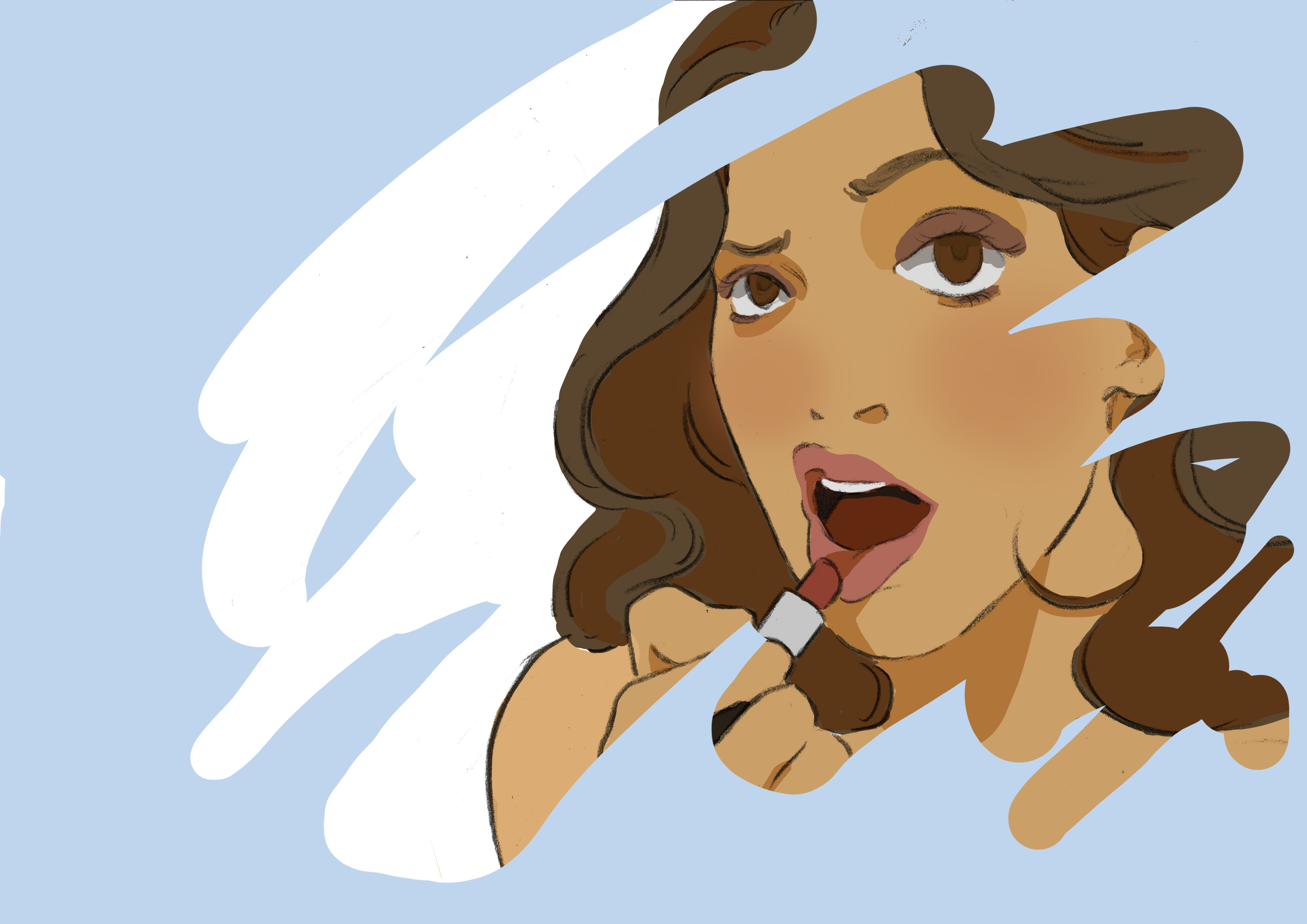
Illustration by Lydia Kempton (IG: @lydiak_arts)
By Coline Coubat
‘Women fall in love with what they hear, and men fall in love with what they see. That’s why men will always lie, and women will always wear makeup.’
That was the statement I heard while scrolling through videos absentmindedly. Beyond questioning how I ended up on this side of the algorithm, the words spurred a train of reflection within. As a woman who has been wearing makeup since her early teens, there were moments where I was confronted with the reality that some people saw the use of makeup as a form of deceit. However, on the days I chose not to wear makeup, I was on the receiving end of ceaseless ‘you look tired today’ and ‘are you okay?’s.
Sentiments like the ones expressed in the video which allude to the view that women who wear makeup are liars, fabricating their appearance and masking their ‘real’ faces, are not rare. as We hear jokes telling us to ‘take her swimming on the first date’ and allegories of catfishing women, presenting women’s use of makeup as a way to deceive men. Makeup becomes an extension of the other perceived ways in which women are believed to use their appearance and body to attract, manipulate, and get what they want.
What is hard to digest and goes unmentioned in these beliefs, however, is the reality of a lack of the ‘correct’ choice for women in relation to makeup, as society holds women down with different constructed messages on what to do with their bodies. Standards are imposed upon them, channeled through men, other women, and larger institutions as they generate and relay the focus of beauty and aesthetic through various means, telling us we need to look a certain way. All this for someone on the other end to shake their head– by wearing makeup we choose to uphold a $9.6 billion industry that profits off constructed ideals, and our insecurities.
Women are told to be pretty, but in a natural way. To care about their appearance, but not to come off as vain. To wear makeup, but in a way that does not appear obvious, hide what we’ve deemed to be imperfections, but embrace who you are! At its core, what we’re taught is riddled with contradiction, because that is what oppression does best:ensuring that the marginalized can never win. When one does not conform to societal expectations placed upon them due to their identity or the circumstances they are in, they are often ‘punished’ by the rest of society. Either judged, ostracized, criticized, or discriminated against. Those of us who wear makeup are deceptive, untruthful, or trying too hard and upholding a system, and those who do not are lazy, trying too hard but in another way, unkept.
At the core of this discussion, more than whether one does wear makeup or not, is why women choose to apply makeup before going out, before heading to work, to class, and so on. The dynamic changes drastically when wearing makeup is a pure, deliberate choice versus when it feels like an imperative imposed by society. The issue lies in this sense of obligation, one disproportionately placed on women, and yet also one that is so heavily judged and criticized. The expectation that women should wear makeup is one that has heavy costs, in more ways than the obvious financial one. Skincare and cosmetics are anything but cheap, on top of the aforementioned social criticism that awaits whether we choose to wear it or not.
An oft-heard argument to push back against the rejection of makeup is the use of it in the name of self-expression and artistry. Makeup has long served as a tool for exploring one’s identity and skill, a form of creative expression, even a body of art.

Mei Pang sharing her creative exploration using makeup on TikTok
Though I do not deny that there are instances wherein artistry is the purpose behind makeup– as exemplified by the likes of Mei Pang– I have a hard time viewing this as the general reasoning behind most makeup users. It is hard to see this argument as a general understanding when, at the same time, children branded as ‘Sephora kids’ spend triple-digit sums on shopping sprees on beauty products and waking up hours before school to do a full face of makeup. There is an element of talent in these girls who are executing such trendy makeup styles at a young age, but it is accompanied by a disturbing undertone of why these children even feel the need to spend such time and money to appear a certain way, and how they are rewarded with popularity online through that.
Though the claim may seem bold, the desire for makeup is constructed, by the aforementioned societal expectations, by structures which oppress women by ensuring there is no ‘correct’ standard for them to live by, by companies which profit off of creating insecurities over a wide cast of the population. There is nothing innate about wanting to change our appearance to fit a particular standard, and though we may be told insecurity is a ‘natural part’ of growing up, the beauty and cosmetics industries essentially pour gas over a small spark in order to make the most they can.
This isn’t to say that the power makeup holds is entirely negative.. There are many instances in which makeup can be empowering, including and not limited to the use of it by trans women, who find in makeup a tool to help explore their identity. By engaging with something culturally deemed feminine, trans women are able to affirm their gender identity, and there are a multitude of resources online focused on supporting trans women and their journey to, if they so choose, utilizing makeup as a liberating and powerful tool. Makeup has also been increasingly used by men in recent years, as we have seen a number of popular makeup artists and influencers grow thanks to their utilization of an object associated with women, particularly in the West.
When makeup is used in a manner that defies the standards placed upon our bodies, it can become a tool for resistance, disrupting the normalized to make a statement and, in a sense, reclaim our bodies. Yet, would come with the aforementioned ‘punishment’: societal judgement and ostracization. Once again, there is no easy or simple answer to this, but a number of considerations and layers to the positions we currently find ourselves in.
As is often said, perhaps not enough times, the personal is political. Beyond just purchasing and makeup, how we apply it upholds particular forms of oppression: why do we contour our noses to be pointier and thinner? Why do so many eye products focus on making our eyes look as big as possible? Why do so many makeup brands advertise brightening, whitening, and lightening skin treatments? Makeup does not merely exist as a blank, neutral object with no potentially violent undertones to it. It has been constructed and transformed to uphold a very narrow vision of beauty and the ideal which only accepts a very few number of (primarily white) women into its criteria.
It is not a crime to conform to societal standards. There is no resolution to the double bind that we live in today, as makeup represents a multitude of different meanings, from oppression to liberation, art to conformity, beauty to deception. We can, however, attempt to establish a more critical approach. We can question why gifts for little girls include glittery makeup sets ‘to make them pretty’. We can critique the narratives sold by big beauty conglomerates, and be more conscious of our own judgments, not only towards those around us, but also towards ourselves.

Leave a Reply