
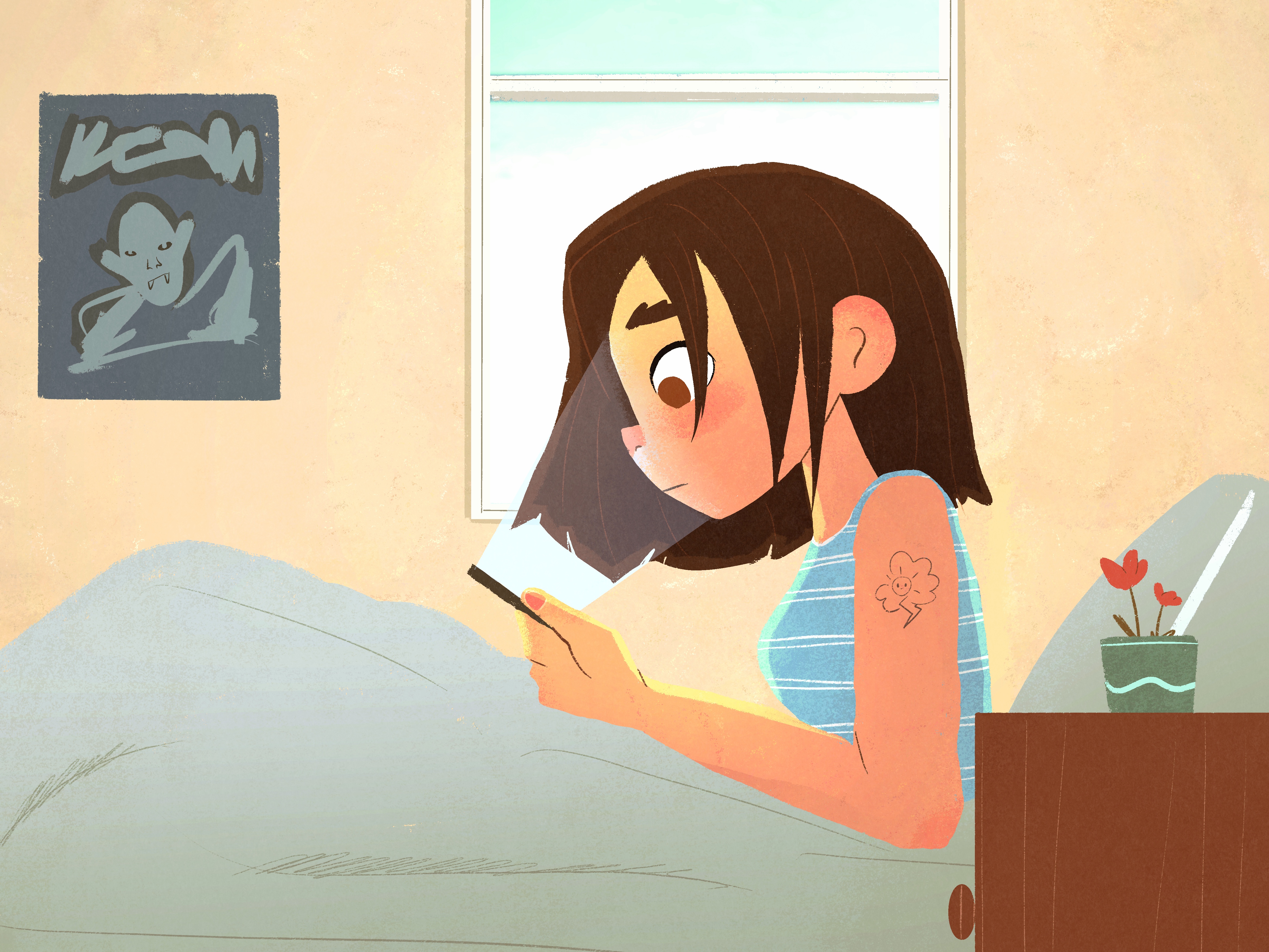
Illustration by Gabriella Handyside
By Elisa Vincent
Any young person living in today’s technological and social climate has been made aware of the acute loneliness affecting Gen-Z. ‘It’s that phone’s fault,’ our parents have told us repeatedly. Though we’ve protested this, it may be time to consider that they are at least partly correct.
The term ‘bed rotting’ has sprung up recently on social media, pointing to a growing trend of, as the name suggests, ‘rotting’ in bed, usually doomscrolling on our phones. It has become a part of our generation’s vocabulary, with ‘going for a rot’ becoming as normalised as going for a walk.
The many hours I, too, have put in doomscrolling have led me to wonder: could these phenomena be correlated somehow? Could Gen-Z’s loneliness crisis be at least partly attributed to our tendency to shut ourselves up in our bedrooms and spend hours on social media without actually speaking to anyone?
A 2024 study by the American Academy of Sleep Medicine finds that 24 per cent of young people aged 18-24 report bed rotting. Considering the growing popularity of the practice, we can only assume this has increased since. Indeed, one third-year student tells me she frequently sets her alarm earlier than necessary by even a few hours to spend more time in bed, and that bed rotting often cuts into her sleep at night.
Of course, there are reasons for this. The most obvious being that it allows us to rest and relax, especially after a long day of lectures and university work. The student tells me, quite simply: “I like my bed.” With the cost of living continuously increasing, it also provides us with a cost-free activity we can do from the comfort of our own homes (if you can call bed rotting an activity).
So, Gen-Z is bed rotting. Gen-Z is also feeling increasingly lonely. A study by Cigna reports that 73 per cent of workers aged 18-22 feel sometimes or always alone. Though we’re incredibly connected to each other by social media, it also seems to be one of the root causes of this loneliness: the study finds that 71 per cent of heavy social media users feel loneliness, compared to 51 per cent of light social media users.
It is no mystery that the more time we spend bed rotting, the more time we spend on social media, disconnected from the world. Why does it make us so lonely? When we doomscroll, we’re bombarded with content of people spending time together–our friends, family, and social media influencers alike. People rarely post about time spent alone. Rather, they share moments with others, which we consume alone from our bedrooms. Not only does this foster feelings of comparison, it can also create parasocial relationships, and lead us to replace time spent with others with time spent on our phones.
Bed rotting, social media, and mental health seem to share a cyclical relationship. Not only is extensive time spent doomscrolling social media leading to negative effects on our mental health, poor mental health seems to lead to more time spent bed rotting. The practice is also frequently used as a coping mechanism, as it’s an activity that doesn’t require much brainpower, doesn’t elicit any anxiety, and doesn’t require interacting with anyone. The student I spoke to tells me her bed rotting habits are tied to seasonal depression, and the hours she spends in bed increase in the winter months: “If I spend more than four hours in bed a few days in a row, I would say it’s getting bad again.” She tells me that the activity’s solitary aspect is, in fact, appealing to her: “[At night] I like the appeal that no one is awake, no one is trying to reach me.”
I’ve also noticed how comfortable we, as a generation, have become with cancelling plans in the guise of ‘self-care’, which usually translates to bed rotting. Of course, we should all look after our mental health as much as possible. But giving up real human interaction to spend hours on our phones fragments relationships and prevents us from forming meaningful connections.
I’m not trying to claim that we should all stop spending time on our phones; no one can deny that after a long day, it can feel so good to crawl into bed, doomscroll, and forget all about our problems. It’s unrealistic to cut the practice out completely. However, shutting ourselves up for hours to scroll TikTok and Instagram is damaging. It contributes to a growing epidemic of loneliness and eliminates feelings of community and genuine connection.

Leave a Reply